Movement & Injury Prevention Tips
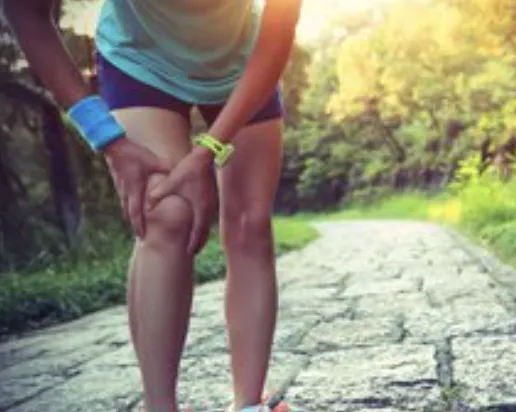
Knee Pain When Running: Root Causes & Fixes | Dr. Heather
Knee Pain When Running:
A Movement Coach's Approach to Runner's Knee
Knee pain when running is one of the most common complaints I hear from runners — and one of the most misunderstood.
You've probably tried the usual advice: ice it, rest it, maybe do some quad stretches. And it probably helped — until you started running again. Because the pain always comes back. And every time it does, you run a little shorter, a little more cautiously, wondering if your running days are numbered.
Here's what I've found after 25+ years working with runners: knee pain when running is almost never actually a knee problem. The knee is where you feel the pain, but the cause is upstream — in your hips, in your gait, in movement imbalances your body has been quietly accumulating for years.
Fix the movement, and the knee pain resolves. Keep treating only the knee, and it keeps coming back.
What Is Runner's Knee? (And What's Actually Happening)
"Runner's knee" is a catch-all term that most often refers to patellofemoral pain syndrome (PFPS) — pain around or behind the kneecap that worsens with running, stairs, squatting, and sitting for long periods. It accounts for roughly 25% of all running injuries and affects runners of every level.
The kneecap (patella) sits in a groove at the bottom of the femur and glides up and down as your knee bends and straightens. When everything is aligned and moving correctly, the patella tracks smoothly in that groove. But when it doesn't — when it pulls slightly to one side, or when the forces running through it are uneven — the cartilage underneath gets compressed and irritated, and you get pain.
The question is: what's causing the patella to track incorrectly? Almost always, the answer is somewhere else in the kinetic chain.
The Real Root Causes of Knee Pain When Running
1. Weak Hip Stabilizers — The #1 Culprit
The research on this is remarkably consistent: runners with patellofemoral pain almost universally show weakness in their hip abductors and external rotators — especially the gluteus medius.
Here's why it matters for your knee: every time your foot hits the ground during running, your body is balanced on one leg. If your hip stabilizers aren't strong enough to hold the pelvis level, the femur drops and internally rotates. That inward rotation of the femur changes the angle at which the kneecap tracks in its groove — pulling it toward the outside and creating uneven compression on the cartilage underneath.
The pain is in your knee. The cause is in your hip. This is why strengthening the quad alone almost never solves runner's knee long term.
2. Dynamic Knee Valgus (Knee Cave)
Watch your knee from the front as you run, step down stairs, or do a single-leg squat. Does it drift inward toward the midline? That inward movement — called dynamic knee valgus — is one of the most reliable predictors of patellofemoral pain in runners.
Knee valgus is itself a downstream effect of inadequate hip control. When the glute med and hip external rotators can't hold the femur in proper alignment, gravity and ground reaction forces pull it inward, dragging the kneecap off its track with every step.
3. Overstride and Increased Impact Loading
Runners who overstride, landing with the foot well in front of the body's center of mass, experience higher impact forces through the knee with each step. The patellofemoral joint can handle a lot of load, but repetitive high-impact landing on an already-stressed joint accelerates breakdown.
Increasing your cadence (steps per minute) is one of the most well-supported interventions for reducing patellofemoral load, because it naturally shortens your stride and shifts your landing point under your hips.
4. Tight Lateral Structures (IT Band and TFL)
When the IT band and tensor fasciae latae (TFL) are tight, they pull the kneecap laterally, directly opposing the medial structures that keep it on track. This lateral pull is a direct source of compression and irritation at the outer edge of the patella.
This is why runner's knee and IT band syndrome often coexist. They share the same upstream root cause: inadequate hip stabilization combined with overactive lateral hip structures.
5. Poor Ankle Mobility and Foot Mechanics
Restricted ankle dorsiflexion (the ability to flex the foot toward the shin) is a consistently overlooked contributor to knee pain. When the ankle can't move freely, the knee compensates often by collapsing inward. Similarly, excessive pronation at the foot causes tibial internal rotation that travels straight up the chain to the knee.
Why the Standard Approach Keeps Failing
Most runners with knee pain are told to stretch their quads, strengthen their VMO (the teardrop-shaped muscle above the inner kneecap), and rest. Some also get a knee sleeve or orthotics.
These interventions can reduce symptoms in the short term. But none of them address why the knee is being loaded incorrectly in the first place. The hip isn't stronger. The gait pattern hasn't changed. The foot mechanics are the same. So when you return to running, you return to the same stress pattern, and the same pain returns.
Knee pain when running is a movement problem. It requires a movement solution.
The Corrective Movement Approach
When I work with a runner dealing with knee pain, here's the framework I use:
Assessment first. I need to see how the hip is stabilizing during single-leg loading, what the gait pattern looks like, and whether there's a crossover, hip drop, or knee cave happening in real time. The exercises are chosen based on what I find not a generic protocol.
Hip strengthening in running-relevant positions. Clamshells and side-lying leg raises have their place early in rehab, but they don't directly train the hip stabilizers to do their job while running. The progression needs to include single-leg loading, step-downs, and eventually running-specific drills that train the hip to hold the pelvis level under load.
Gait retraining. This might include cueing a wider step width to reduce valgus stress, increasing cadence to reduce impact, or addressing trunk lean. Small gait changes, consistently applied, create large reductions in knee stress over the thousands of steps of a run.
Ankle and foot work. If restricted ankle mobility or foot pronation is contributing, addressing these removes a major source of the forces driving knee valgus.
Gradual load reintroduction. As the movement pattern improves, running load is systematically reintroduced not as a reward for pain reduction, but as part of the retraining process.
Watch: How Dr. Heather Helped a Runner Get Back After Knee Injury
This is exactly the kind of transformation that happens when you stop chasing knee symptoms and start correcting the movement pattern underneath them.
What You Can Do Right Now
Single-leg squat test. Stand in front of a mirror. Lower into a single-leg squat on one leg. Does your knee drift inward? Does your opposite hip drop? If yes, hip control is almost certainly contributing to your knee pain.
Check your cadence. Use a running app or metronome to count your steps per minute. Most recreational runners are in the 150–160 spm range. Increasing toward 170–180 spm significantly reduces impact loading at the knee.
Film yourself running. A 30-second clip from the front and from the side will show you more than any amount of self-assessment. Look for knee cave, hip drop, and whether your foot is landing under your hip or out in front of it.
One honest note: self-assessment can point you in the right direction, but it can't replace a full movement evaluation. Runner's knee has multiple possible root causes, and exercises designed for the wrong one won't fix and can worsen your specific case.
The Bottom Line
Knee pain when running is not a knee problem. It's a movement problem that shows up as knee pain and it will keep showing up until the movement is corrected.
The good news: patellofemoral pain responds extremely well to a proper corrective approach. The runners I work with who commit to understanding and fixing their movement pattern don't just get out of pain they run stronger, more efficiently, and with far less risk of re-injury.
Tired of knee pain cutting your runs short? Book a free movement consultation — I'll assess the actual movement patterns behind your knee pain and give you a clear path forward. No guessing, no generic protocols.
You can also explore my 1:1 coaching program for a fully personalized plan built around your body, your running goals, and your specific injury history.
Dr. Heather Gansel is a movement specialist and performance coach with 25+ years helping runners resolve chronic pain by identifying and correcting the root-cause movement imbalances behind their injuries. She works virtually with runners worldwide. Learn more.