Active Release Technique (ART) for Runners | Ask Doctor Heather
If you've dealt with a stubborn running injury, IT band tightness that won't respond to foam rolling, plantar fasciitis that persists despite stretching, or calf tension that never fully releases you may have encountered the term Active Release Technique. You may also have gotten confusing or vague answers about what it actually does.
Here's a clear explanation of what ART is, how it works for runners, and when it belongs in a treatment plan.
What Active Release Technique Is
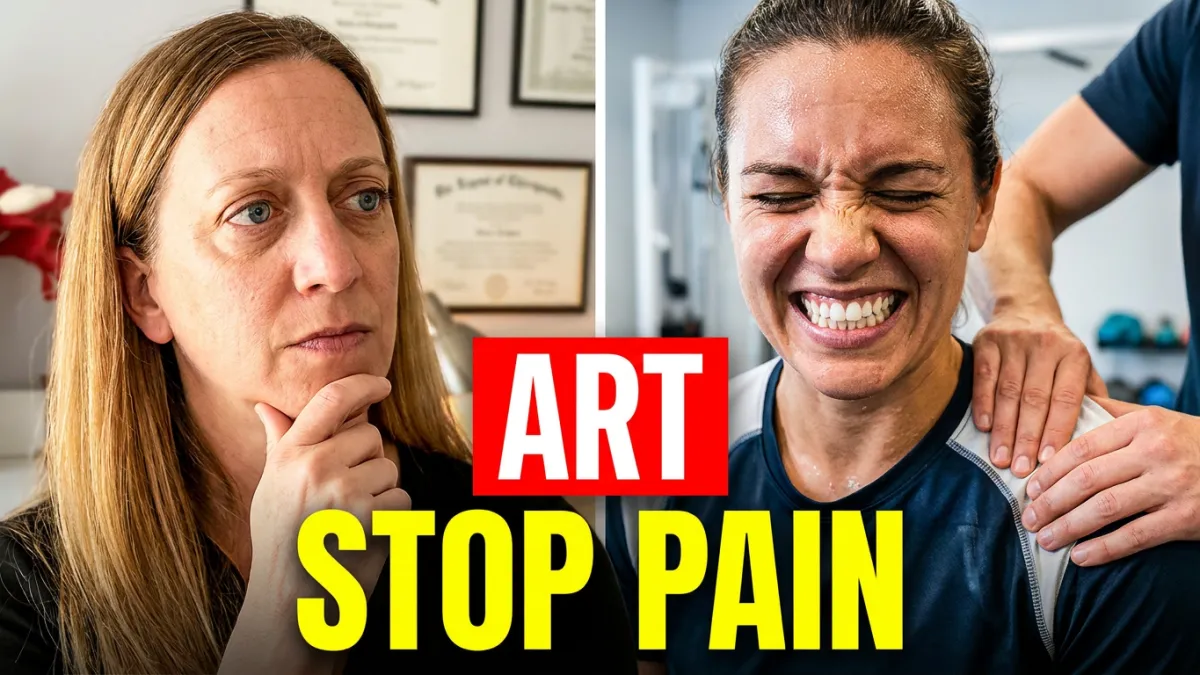
Active Release Technique (ART) is a patented soft-tissue treatment system developed by Dr. P. Michael Leahy in the 1980s. It's a hands-on method used to break up adhesions and scar tissue that form between muscles, tendons, ligaments, fascia, and nerves following injury, overuse, or chronic tension.
The core mechanism is precise. The practitioner applies direct, specific tension to a soft tissue structure, and then the patient actively moves through a range of motion while that tension is maintained. The combination of the external tension and the active movement creates a shearing force on the adhesion essentially pulling the stuck layers apart.
This is different from massage (which doesn't require active movement and typically doesn't apply the same specificity of tension) and different from stretching (which doesn't address the adhesion itself, only the length of the tissue around it).
Why Runners Develop Adhesions
Running generates significant, repetitive mechanical stress on soft tissues. Every foot strike creates a shockwave through the body. Tendons, muscles, and fascia absorb that stress over thousands of repetitions per run.
When that stress exceeds the tissue's capacity to recover, micro-damage occurs. The healing process lays down scar tissue to repair the area and that scar tissue, while structurally sound, is often disorganized and creates adhesions between tissue layers that should be able to slide freely against each other.
These adhesions restrict movement, reduce blood flow to the area, and alter the firing patterns of the surrounding muscles which is why soft tissue problems that seem purely structural often have a movement and neurological component as well.
Common sites in runners include the IT band and its attachments at the hip and knee, the plantar fascia, the calf-Achilles complex, the hip flexors, the hamstrings at the ischial tuberosity (proximal hamstring tendinopathy), and the peroneals on the lateral ankle.
What ART Actually Treats in Runners
ART is most effective when there is an identifiable adhesion or restriction in a specific soft tissue structure. The injuries where I've seen it work best in runners:
IT band syndrome: The IT band itself can't be released (it's not a muscle and doesn't have meaningful stretch capacity), but the surrounding tissues like the TFL, glute medius, lateral quad, and biceps femoris develop adhesions that alter IT band tension. ART to those structures, combined with corrective exercise for the underlying hip stability issue, is significantly more effective than either alone.
Plantar fasciitis: The plantar fascia and the intrinsic foot muscles frequently develop adhesions from the repetitive loading of running. ART to the plantar fascia, combined with addressing the hip and ankle mechanics that are creating the overload, produces faster resolution than stretching alone.
Achilles and calf complex: The gastrocnemius and soleus develop adhesions from repetitive eccentric loading. ART to the calf, combined with eccentric strength work, is the evidence-supported approach to tendinopathy that doesn't respond to rest and stretching.
Hip flexor restriction: Chronically tight hip flexors from sitting and running rarely release fully with stretching because the restriction is often adhesion-based, not just muscle tightness. ART to the psoas and iliacus can restore range of motion that affects stride length, pelvic position, and low back loading.
Proximal hamstring (high hamstring) tendinopathy: One of the more stubborn running injuries, proximal hamstring issues respond well to ART combined with eccentric loading protocols.
What ART Doesn't Fix
ART treats the soft tissue consequence, the adhesion. It doesn't address the mechanical cause.
If the reason your IT band is compressed is because your glutes aren't stabilizing your pelvis at foot strike, clearing the adhesion will provide relief but the compression will return because the underlying movement problem is still active. The same is true for plantar fasciitis, Achilles issues, and most other overuse injuries.
This is the most important limitation to understand. ART is a valuable treatment tool. It's not a corrective exercise program, and it doesn't address movement patterns. Runners who rely on ART alone often find themselves returning for repeat treatments as the adhesions reform because the mechanism creating the problem hasn't changed.
The most effective approach uses ART to restore tissue quality and normal movement capacity, then immediately follows with corrective exercise to address the underlying movement problem causing the overload.
How to Know If ART Is Right for Your Situation
ART is most indicated when:
You have a specific, palpable restriction or tender point in a soft tissue structure (rather than diffuse pain)
The injury has been present long enough to have developed scar tissue (typically more than 4–6 weeks)
Stretching and foam rolling have provided only temporary relief
You have a history of injury in that tissue (previous injuries always leave scar tissue)
ART is less appropriate for:
Acute injuries in the first 48–72 hours (inflammation is still active)
Bony stress fractures or significant joint pathology
Conditions that require imaging or diagnosis before treatment
Finding the Right Provider
ART is a trained certification. Providers complete coursework in specific body regions and must demonstrate competency to maintain certification. For runners, look for providers certified in the lower extremity (at minimum) and preferably the spine and upper extremity as well, since running involves the full kinetic chain.
The Bottom Line
ART is one of the most effective tools I use for breaking through soft tissue restrictions that are limiting a runner's recovery or movement quality. For specific adhesion-based problems, it works faster than massage and more specifically than stretching.
But it's a tool in a larger system, not a standalone solution. Pair it with corrective exercise that addresses the movement cause, and you have a much more durable result.
Book your movement assessment → askdoctorheather.com
Find out what's driving your soft tissue restriction — not just where it is.
Dr. Heather Gansel is a doctorate-trained movement specialist with 25+ years in biomechanics. She works with runners virtually through Ask Doctor Heather, helping them identify and resolve the root-cause movement patterns behind recurring pain and performance plateaus. Follow her on Instagram @drheathergansel.


